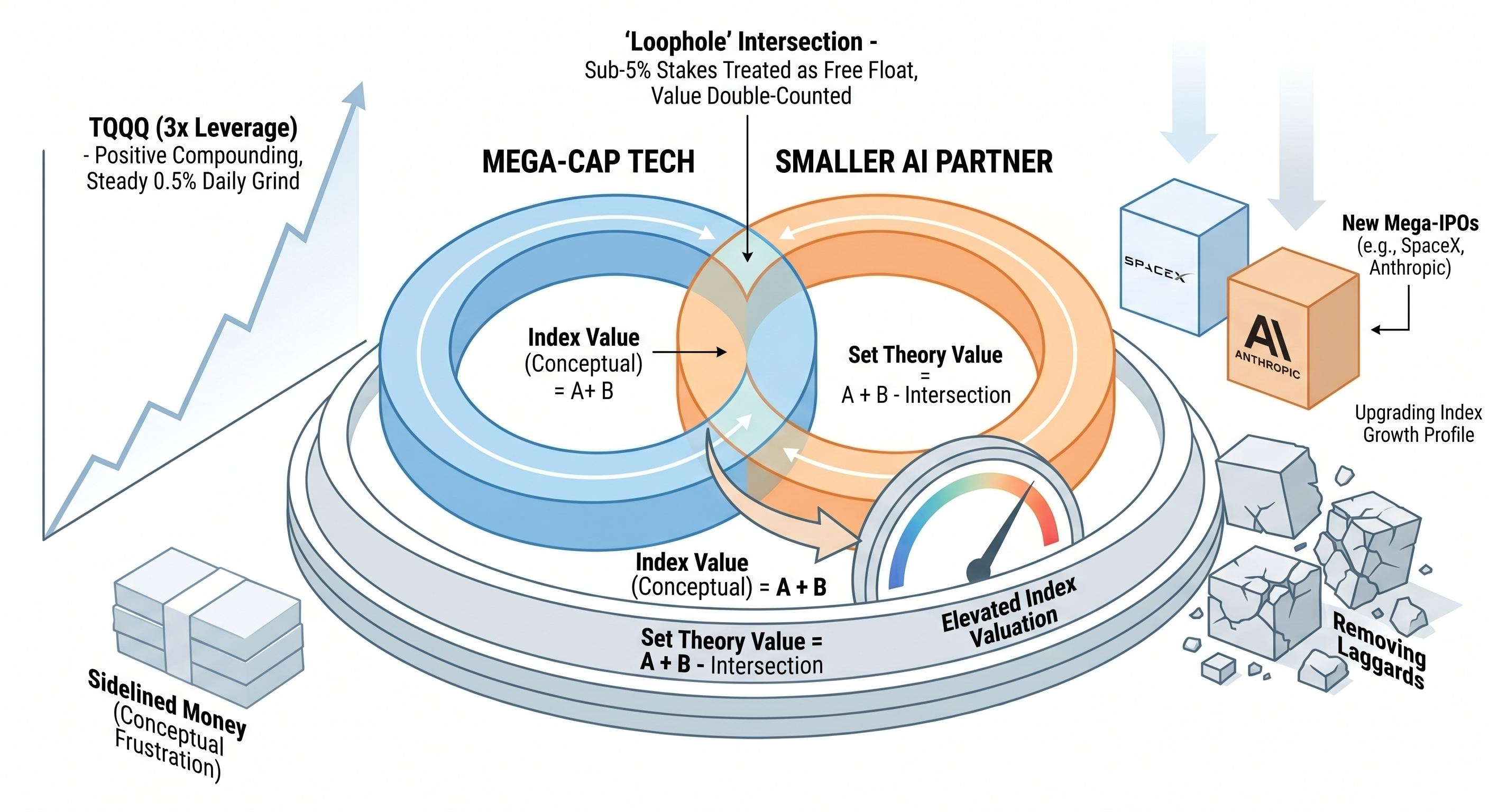
Currently, the market is experiencing a persistent, low-volatility upward grind, with the Nasdaq noticeably outpacing both the S&P 500 and the Dow Jones. While mainstream analysis attributes this entirely to AI enthusiasm and earnings growth, looking closely at modern market plumbing reveals a structural mechanic at play: valuation overlap.
Due to a combination of regulatory reporting thresholds and modern index construction, the Nasdaq is experiencing a partial circularity in its valuation. Here is a breakdown of the mechanics driving this divergence, the algorithmic feedback loop amplifying it, and how we are positioning for it.
Investing in the ‘AI Mafia’: Why the Bricks Always Beat the Brains
Most retail investors are currently obsessed with “The Brains”—the semiconductor companies like Nvidia or AMD. They see the sky-high margins and assume that because AI needs chips, chips are the best way to play the trend.
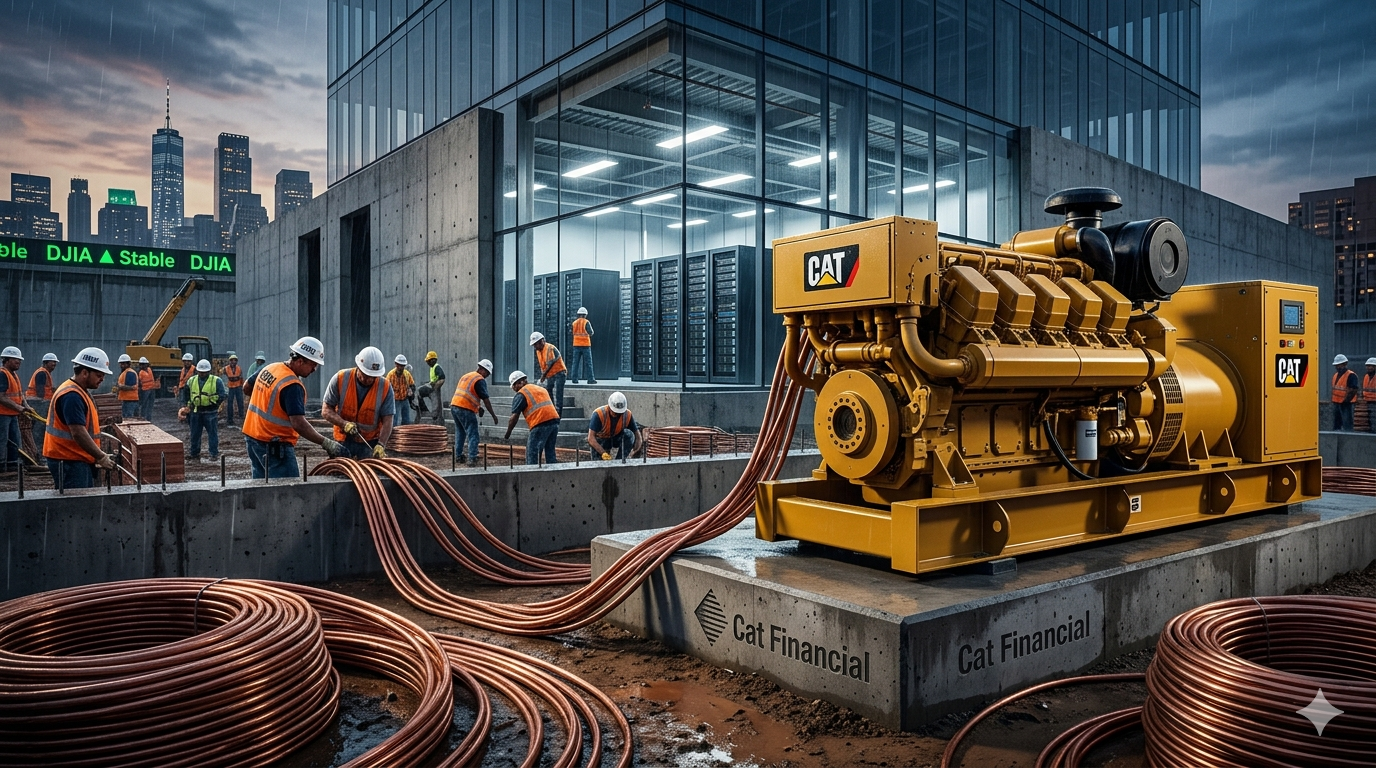
But sophisticated investors know that a chip without power is just an expensive piece of silicon. The real leverage in the AI revolution isn’t found in a cleanroom in Taiwan; it’s found in the dirt, the diesel, and the copper. It’s found with the “AI Mafia”: Caterpillar (CAT) and EMCOR (EME).
I’ve always believed Google (Alphabet) would ultimately win the AI race — not because they’d have the flashiest model every week, but because of deep structural advantages that matter in a capital-intensive, multi-year war.
The market is now reflecting exactly that. Here’s the full thesis that has held up extremely well.
The Core Thesis (written more than a year ago)
They own their own compute (TPUs + custom silicon)
They don’t need to raise money — massive cash flow + ad revenue moat
They already have a huge enterprise business
No painful revenue-share drag with partners
Raw model quality matters less than integration, distribution, and scale
This was never a “best model on the leaderboard wins” game. It’s a game of attrition, economics, and distribution.
If you have been following my prior articles and videos at retailtrader.ai, you know we’ve been tracking the structural shifts beneath the AI hype. Recently on CNBC, ServiceNow’s CEO touted that AI is handling massive chunks of customer service workflows, suggesting companies won’t need to backfill human employees.
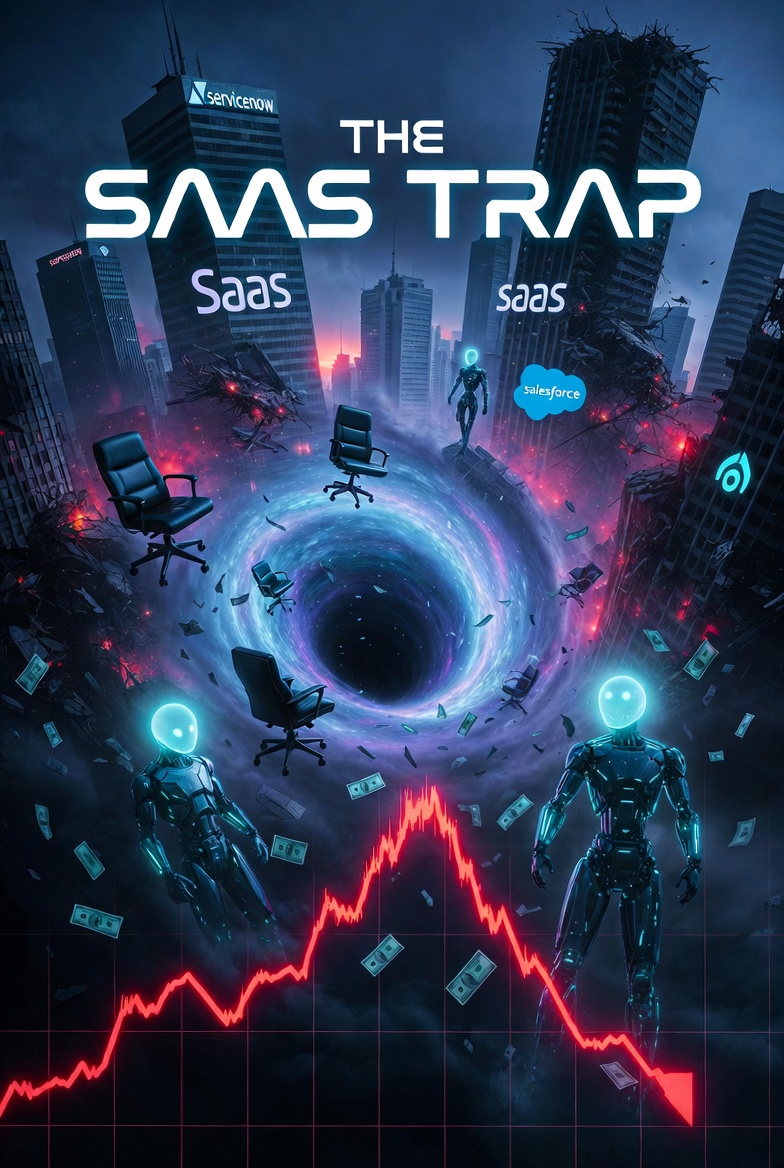
Wall Street is cheering this as a massive productivity tailwind. I am looking at it and seeing a deflationary trap that will eventually gut the legacy SaaS business model.
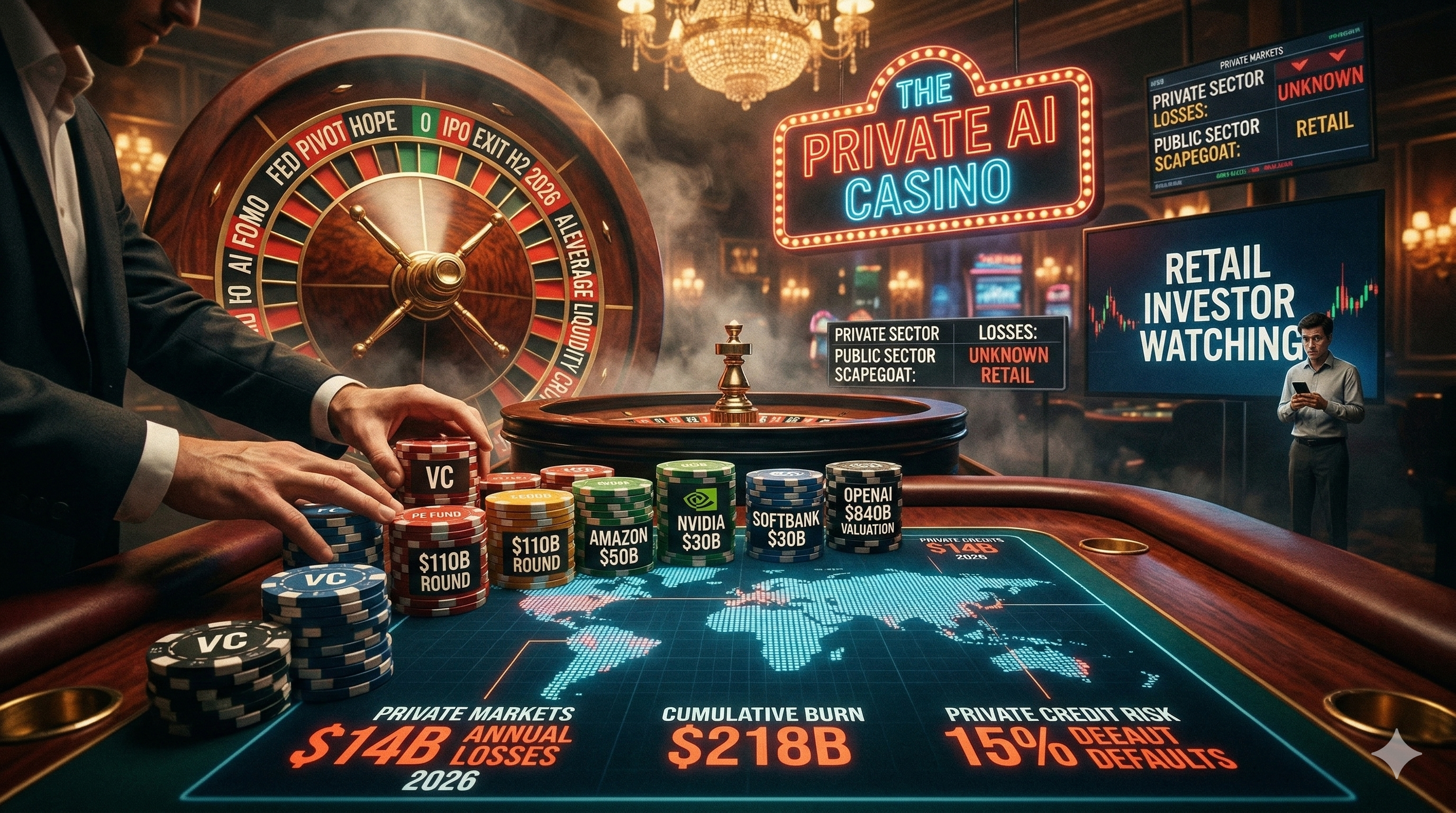
Retail investors were taken for granted by VCs — just like certain elites took voters for granted in 2016. Now the backlash is building, and SpaceX is perfectly positioned to benefit.
I’ve been trading through this entire AI cycle, and the parallels to 2016 keep getting stronger.
For years the venture capital crowd ran the same playbook:
Massive private rounds at insane valuations (Databricks at $134 billion after its latest big 2026 round, Anthropic pushing toward $380 billion, OpenAI in the $800 billion+ stratosphere).
Kept companies private as long as possible to maximize marks and carry.
Locked retail out completely.
Then expected the public to show up and buy when they finally decided to IPO.
They took retail for granted — just like certain elites took voters for granted in 2016, assuming loyalty and that we had nowhere else to go. The result back then was a surprise shift. The same dynamic is playing out now.
If you are worried about your SaaS company stock options or ESPP right now, you aren’t the only one. Many tech employees and investors are looking at their portfolios and wondering what comes next.
As a market practitioner, I’ve been tracking the severe hit SaaS companies are taking, and unfortunately, it doesn’t look like a temporary dip. In my latest video, I break down the macroeconomic conditions driving this correction and why the fundamental nature of software is changing.
The AI boom remains the loudest story in markets—hyperscaler capex announcements, data-center expansions, and the long-term promise of transformative productivity continue to dominate headlines, earnings calls, and investor attention. Beneath that surface, however, a clearer and more pressing dynamic is unfolding: the market’s leadership stocks—the “generals”—are under sustained pressure from geopolitical escalation, severe energy market disruptions, rising inflation risks, and deteriorating risk sentiment. This goes beyond routine tech “digestion”; it’s leadership exhaustion amid real macro and geopolitical headwinds, while AI infrastructure players (the “shovel sellers” of the gold rush) press forward aggressively.
While the public markets whip around on oil spikes, geopolitics, and Fed speculation, the mainstream narrative remains unchanged: Retail investors are the reckless “YOLO” crowd. We’re told they’re the gamblers, chasing memes and options with small stakes and full daily transparency.
I was at an investor meeting the other day. It wasn’t for my own company, but I got to watch a lot of founders proudly talking about their businesses. It reminded me of all the posts you see on LinkedIn where people brag about raising $10 million from a venture capitalist like it’s the ultimate achievement.
When Jack Dorsey announced on February 26, 2026, that Block (the parent of Square and Cash App) was cutting more than 4,000 jobs—nearly half its workforce from over 10,000 to under 6,000—the markets responded enthusiastically. Shares surged 20–25% in after-hours trading, and Block raised its 2026 gross profit guidance to ~$12.2 billion after strong 2025 results.
Yesterday, we held our very first live open house for retailtrader.ai. It was an incredible opportunity to connect with our community and share the “why” behind this platform. For those who couldn’t make it, the full recording is now available.
The Motivation: Built on Integrity
My path to building this platform wasn’t typical. After 25 years in the software industry and 15 years of trading, I witnessed a $300 million corporate fraud at my previous company. That experience fundamentally changed my perspective.
The Macro Wave Behind 2026’s Selective Tech Correction: AI Deflation Hits Software Pricing Power
Introduction
The market is not experiencing a uniform tech correction. While some names hold steady or rebound, others—particularly those tied to OpenAI’s ecosystem or reliant on legacy pricing models—are facing sharp, persistent declines.
Most commentary treats these as isolated events: hype fade, earnings misses, or macro caution. But a deeper macro regime shift is at work: generative AI is proving deflationary for software pricing power, commoditizing what was once proprietary and high-margin, forcing a permanent repricing of certain tech businesses.
While you’re waiting for kickoff, I wanted to share a quick update on our flagship feature: Curated Trades.
The market has been extremely volatile over the last couple of weeks. Tech stocks have been decimated, and many portfolios are seeing red. We launched our Curated Trades engine right in the midst of this chaos, so I was curious myself to see how the model would handle the stress test.
For the last few months, we have focused on building a best-in-class data engine—decoding market noise using complex neural networks. We proved that the “retail” trader could have access to institutional-grade data.
But data alone doesn’t place the trade.
Today, we are officially opening the Execution Desk at retailtrader.ai.
We are proud to introduce the Pro Plan and our flagship workflow: Curated Trades.
The Problem: Analysis Paralysis
We built this platform for the working professional. You don’t have time to stare at charts for 6 hours a day, and you don’t need more “noise.” You need a managed lifecycle that moves you from raw data to a clear, mathematical edge.
This week, we officially launched Curated Trades at retailtrader.ai. During the development process, I faced a major decision regarding our Pro Plan risk profiles.
The data gave us two clear paths:
The Ferrari: ~95% annualized returns. High speed, high reward, but high-G force (15%+ drawdowns).
The Tank: ~40% annualized returns. Systematic, steady, and built for the long haul.
Personally, I trade like a Ferrari driver. But most retail traders are working professionals looking for a systematic “Execution Desk” that doesn’t keep them up at night. We chose The Tank.
The most dangerous thing in trading isn’t volatility. It’s isolation.
Most retail traders fail because they are trying to beat institutional algorithms while sitting alone in a room. They have the charts, but they don’t have the conviction.
At retailtrader.ai, we solved the data problem first. Our neural networks scan the market 24/7 to find high-probability setups (like the $AAPL and $NVDA signals we caught last week).
But data is only half the equation. Execution is the other half.
In software, the new paradigm is “Vibe Coding”—AI writes the code, Human verifies the logic.
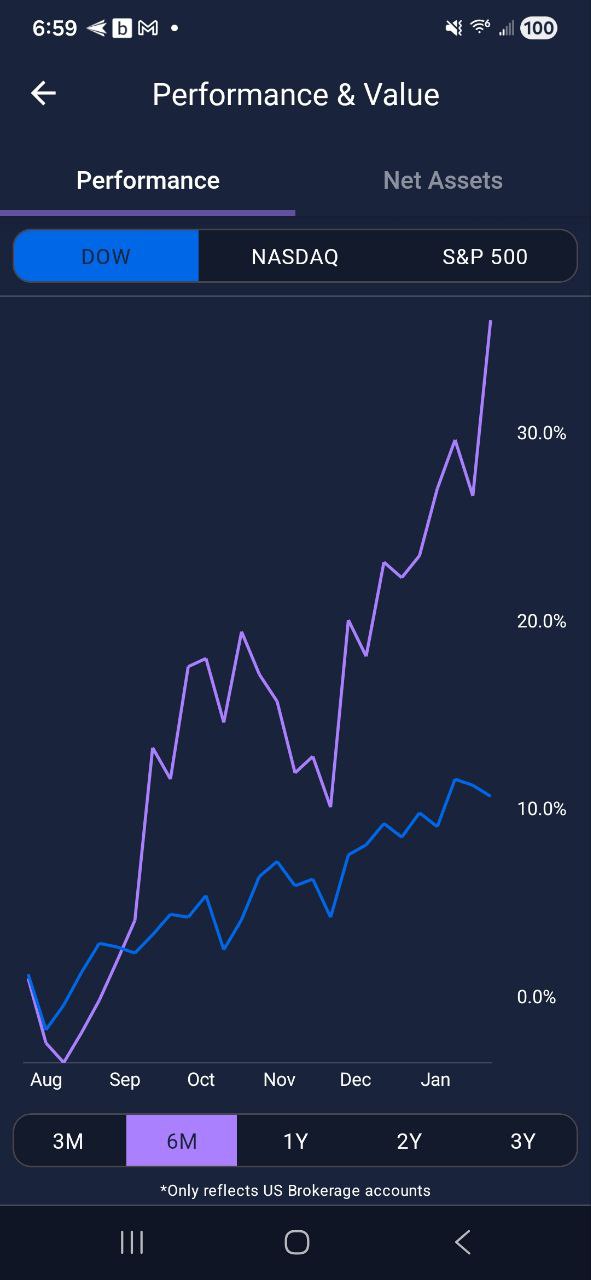
At retailtrader.ai, we applied this exact architecture to retail execution, and the results are in the chart below. 📉📈
THE “PURPLE LINE” (My Personal Portfolio) vs. THE “BLUE LINE” (S&P 500)
While the market chopped sideways this month, my personal account broke out vertically (+40%).
HOW OUR “VIBE” WORKFLOW WORKS:
The Heavy Lifting (AI): Our engine scans the market overnight and generates precise “Pending Orders” (Entry Price, Stop Loss, and Targets) for the next day.
The Verifier (Me): I check the signals in the evening. If I like the setup, I place the pending order with my broker.
The “Anti-Hurry” Advantage: Unlike alert services that demand you act in split seconds, our signals are designed for Pending Orders. You have hours to verify the chart, check the news, and decide—without the FOMO or the rush.
The next day? I don’t watch the screen. The market either triggers the order, or it doesn’t. This is the difference between “working” for your alpha and “verifying” it.
Selectivity vs Volume: Why Selection is the Ultimate Force Multiplier
In quantitative trading, the validity of a strategy is only as good as its constraints. At retailtrader.ai, we utilize an Exact Parity Simulator that treats our strategy with the same rigor as a professionally managed fund. Our latest results reveal a compelling narrative: algorithmic selection transforms raw market signals into institutional-grade alpha.
Context of Performance
Out-of-Sample Data: These results represent live data tracked since our launch in Nov 2025, representing ~50 days. While the metrics are subject to short-term compounding due to the short time window, it demonstrates the general efficacy and the positive alpha of the methodology used.
Normalization: We fully expect these extraordinary figures to normalize as market conditions shift.
Live Signals: This simulation shows how the system would have performed if you followed the actual live signals delivered to our users since our launch in the real-world environment.
1. Experimental Design: The “Physics” of the Forward-Simulation Test
Most retail systems generate massive mental stress by forcing users to chase nanosecond ticks. We reject that model in favor of First Principles. Our architecture is specifically tailored for a “Fire and Forget” approach:
A deep dive into the hybrid architecture behind retailtrader.ai—combining deep learning for pattern recognition with deterministic logic for risk management.