The SaaS Trap: Why AI's Productivity Boom is a Deflationary Death Spiral for Incumbents
retailtrader.ai
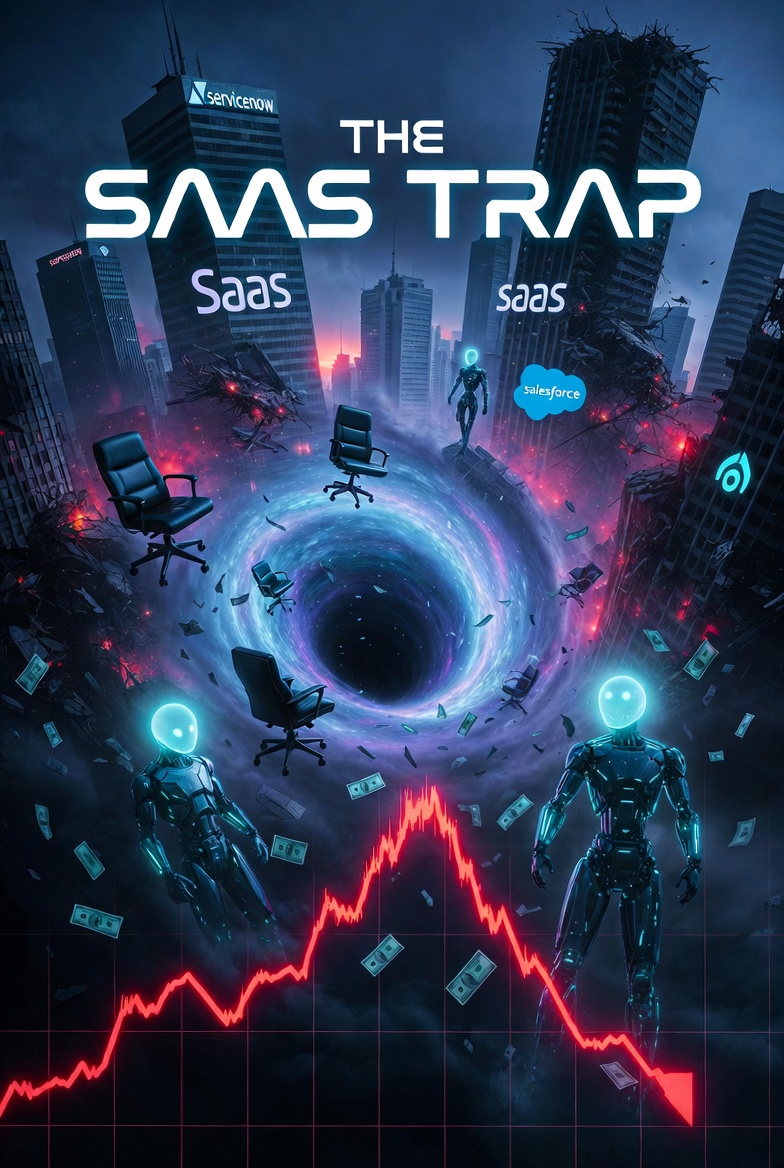
If you have been following my prior articles and videos at retailtrader.ai, you know we’ve been tracking the structural shifts beneath the AI hype. Recently on CNBC, ServiceNow’s CEO touted that AI is handling massive chunks of customer service workflows, suggesting companies won’t need to backfill human employees.
Wall Street is cheering this as a massive productivity tailwind. I am looking at it and seeing a deflationary trap that will eventually gut the legacy SaaS business model.
The market is currently treating AI as a pure margin-expander. But if you look past the short-term earnings bumps, the foundational mechanics of enterprise software are breaking. Here is why the legacy giants are living on borrowed time.
1. The Seat-Count Paradox
The math for legacy SaaS is simple and brutal. Companies like $NOW, $CRM, and others built their empires on per-seat pricing. If AI genuinely makes workforces 20% to 30% more efficient, and companies stop backfilling roles (as we are already seeing), those companies inherently need fewer software seats.
The incumbents are trying to pivot to “agent-based” or “consumption-based” pricing to make up the difference, but they are essentially selling the rope to hang their own TAM (Total Addressable Market). Shrinking headcount ultimately means a shrinking revenue base.
2. The Commoditization of the Application Layer
When money was free during the ZIRP era, venture capital subsidized “growth at all costs.” Companies could offer massive discounts to capture market share. Today, capital isn’t free, but AI is acting as the ultimate technological subsidy.
AI makes building software radically faster and cheaper. It lowers the barrier to entry to the floor. Ten hungry startups can now build a lean, AI-native CRM or ITSM tool in a fraction of the time it used to take. Because their overhead is practically zero compared to the bloated incumbents, they can compete on razor-thin margins. We are entering an era of hyper-competition at the application layer, and that means one thing: an absolute race to the bottom for software pricing.
3. AI Kills the “Compliance Premium”
The loudest bull case for legacy enterprise software is the “moat” of compliance. The old logic was that massive enterprises had to buy Salesforce or ServiceNow because scrappy startups couldn’t navigate GDPR, SOC2, HIPAA, or FedRAMP. They paid a massive premium for an “insurance policy”—a reliable throat to choke if things went wrong.
That moat is evaporating. AI has fundamentally shifted us from “Compliance as a Service” (requiring armies of expensive Big 4 consultants) to “Compliance as Code.” Today, regulatory frameworks and data masking are built natively into foundational AI models and vector databases. Startups can now achieve Fortune 500-level compliance for a fraction of the cost. The legacy tax is losing its justification.
4. The “CFO Override”
The “nobody ever got fired for buying IBM” mentality only survives until the dollar amount becomes an existential problem.
If an enterprise is paying a legacy vendor $10 million a year, and an AI-native startup proves they can deliver 90% of the functionality—plus built-in compliance—for $1 million, the math becomes impossible to ignore. A $9 million savings drops straight to the bottom line.
In a market where margins matter again, the CFO will eventually override the CISO and the CIO. Paying the legacy “safety premium” transforms from a best practice into a massive destruction of shareholder value.
The Macro Reality: Enjoy the Blow-Off Top
We are heading into a structural deflationary era for software, and eventually, the aggregate demand destruction from AI-driven labor displacement will show up in the broader economy.
But for now, we have a market high on margin expansion and the tailwind of Fed rate cuts. Investors will happily bid up tech stocks printing record profits as they lay off staff, ignoring the long-term revenue rot.
Enjoy the ride and trade the momentum while it lasts. But recognize what we are looking at: a blow-off top. When the pricing power of these legacy giants finally breaks, the drop will be spectacular.