The Overlapping Valuation Thesis: Understanding the Nasdaq’s Structural Premium
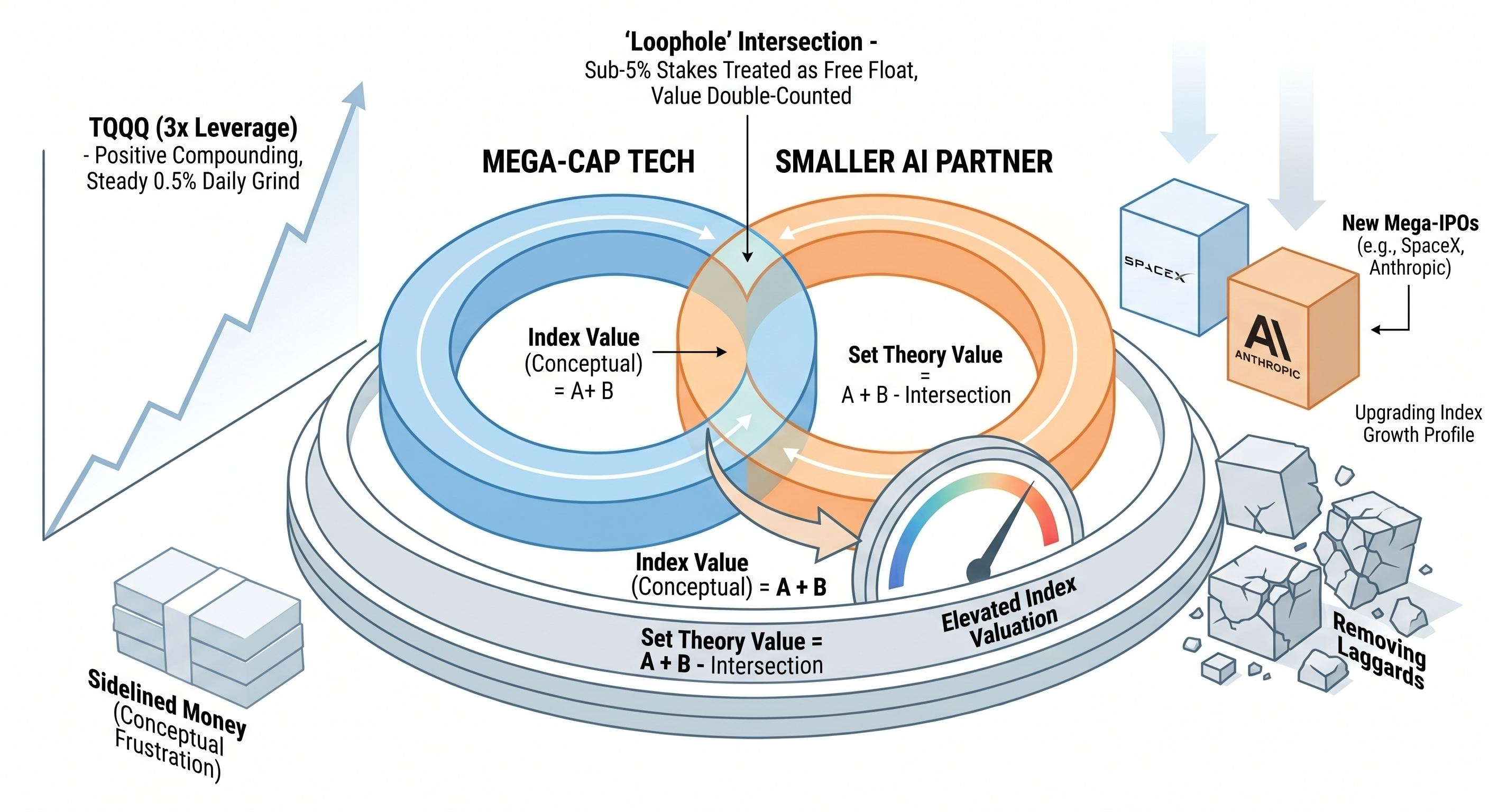
Currently, the market is experiencing a persistent, low-volatility upward grind, with the Nasdaq noticeably outpacing both the S&P 500 and the Dow Jones. While mainstream analysis attributes this entirely to AI enthusiasm and earnings growth, looking closely at modern market plumbing reveals a structural mechanic at play: valuation overlap.
Due to a combination of regulatory reporting thresholds and modern index construction, the Nasdaq is experiencing a partial circularity in its valuation. Here is a breakdown of the mechanics driving this divergence, the algorithmic feedback loop amplifying it, and how we are positioning for it.
Investing in the 'AI Mafia': Why the Bricks Always Beat the Brains
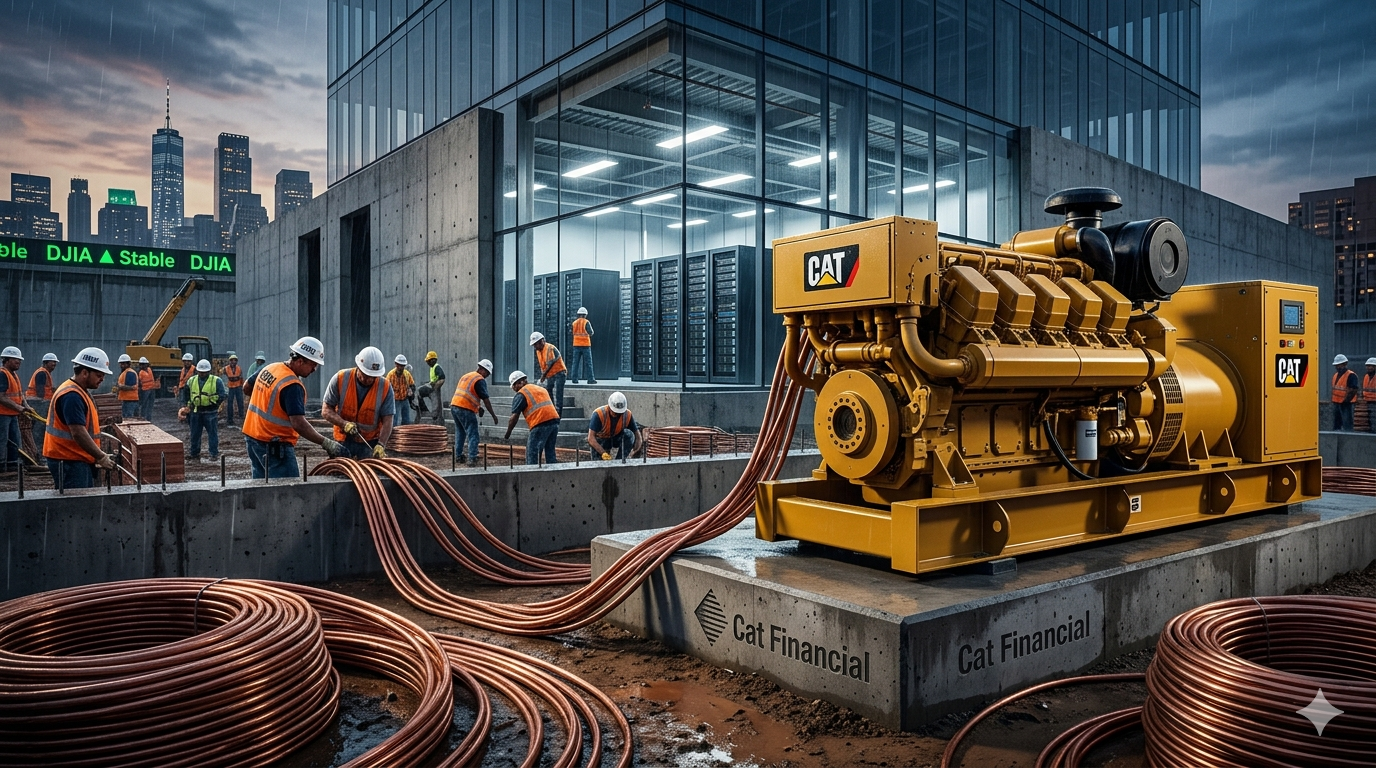
Investing in the ‘AI Mafia’: Why the Bricks Always Beat the Brains
Most retail investors are currently obsessed with “The Brains”—the semiconductor companies like Nvidia or AMD. They see the sky-high margins and assume that because AI needs chips, chips are the best way to play the trend.
But sophisticated investors know that a chip without power is just an expensive piece of silicon. The real leverage in the AI revolution isn’t found in a cleanroom in Taiwan; it’s found in the dirt, the diesel, and the copper. It’s found with the “AI Mafia”: Caterpillar (CAT) and EMCOR (EME).
Why I Always Believed Google Would Win the AI Race
I’ve always believed Google (Alphabet) would ultimately win the AI race — not because they’d have the flashiest model every week, but because of deep structural advantages that matter in a capital-intensive, multi-year war.
The market is now reflecting exactly that. Here’s the full thesis that has held up extremely well.
The Core Thesis (written more than a year ago)
- They own their own compute (TPUs + custom silicon)
- They don’t need to raise money — massive cash flow + ad revenue moat
- They already have a huge enterprise business
- No painful revenue-share drag with partners
- Raw model quality matters less than integration, distribution, and scale
This was never a “best model on the leaderboard wins” game. It’s a game of attrition, economics, and distribution.
The SaaS Trap: Why AI's Productivity Boom is a Deflationary Death Spiral for Incumbents

If you have been following my prior articles and videos at retailtrader.ai, you know we’ve been tracking the structural shifts beneath the AI hype. Recently on CNBC, ServiceNow’s CEO touted that AI is handling massive chunks of customer service workflows, suggesting companies won’t need to backfill human employees.
Wall Street is cheering this as a massive productivity tailwind. I am looking at it and seeing a deflationary trap that will eventually gut the legacy SaaS business model.
Why What’s Happening in AI Is Not Unlike the 2016 Elections

Retail investors were taken for granted by VCs — just like certain elites took voters for granted in 2016. Now the backlash is building, and SpaceX is perfectly positioned to benefit.
I’ve been trading through this entire AI cycle, and the parallels to 2016 keep getting stronger.
For years the venture capital crowd ran the same playbook:
- Massive private rounds at insane valuations (Databricks at $134 billion after its latest big 2026 round, Anthropic pushing toward $380 billion, OpenAI in the $800 billion+ stratosphere).
- Kept companies private as long as possible to maximize marks and carry.
- Locked retail out completely.
- Then expected the public to show up and buy when they finally decided to IPO.
They took retail for granted — just like certain elites took voters for granted in 2016, assuming loyalty and that we had nowhere else to go. The result back then was a surprise shift. The same dynamic is playing out now.
Is AI Killing SaaS? Why Software is the New Iron Ore and Copper
If you are worried about your SaaS company stock options or ESPP right now, you aren’t the only one. Many tech employees and investors are looking at their portfolios and wondering what comes next.
As a market practitioner, I’ve been tracking the severe hit SaaS companies are taking, and unfortunately, it doesn’t look like a temporary dip. In my latest video, I break down the macroeconomic conditions driving this correction and why the fundamental nature of software is changing.
AI Is Not Hype, But the Massive Buildout Will Take Much Longer Than Expected
The last couple of weeks have been brutal for the market, especially for AI-related stocks. The Nasdaq Composite closed at 20,948.36 on March 27, 2026, down over 2% that day alone, extending a painful correction.
In my previous video I warned we might see a significant correction or even bearish pressure. Today I want to share my updated thoughts on where we stand and what I expect going forward.
Alpha in the Chop: +33.88% Over 6 Months and Our Strategic Expansion
It is easy for anyone to look like a market genius in a parabolic bull run. True systematic edge, however, is proven when the tide turns.
Over the last six months, the equity markets have been a brutal, choppy, sideways mess that has punished both buy-and-hold investors and trend-followers alike. From September 26, 2025, to March 20, 2026, the performance of the major indices tells the story:
- S&P 500 (SPY): -2.37%
- NASDAQ (QQQ): -4.35%
- DOW (DIA): -1.59%
In that exact same out-of-sample window, the core CNN-LSTM engine behind retailtrader.ai generated +33.88% across my live brokerage accounts.
Beneath the AI Narrative: The Fall of the Market Generals

The AI boom remains the loudest story in markets—hyperscaler capex announcements, data-center expansions, and the long-term promise of transformative productivity continue to dominate headlines, earnings calls, and investor attention. Beneath that surface, however, a clearer and more pressing dynamic is unfolding: the market’s leadership stocks—the “generals”—are under sustained pressure from geopolitical escalation, severe energy market disruptions, rising inflation risks, and deteriorating risk sentiment. This goes beyond routine tech “digestion”; it’s leadership exhaustion amid real macro and geopolitical headwinds, while AI infrastructure players (the “shovel sellers” of the gold rush) press forward aggressively.
Bear Market Warning: Why This Choppy Action Feels Like the Early Stages of a Prolonged Downturn (March 2026 Update)
The last few weeks have been brutal for anyone trying to trade directionally. The market’s been extremely choppy—spiky up days followed by sharp reversals, massive short squeezes, and volatility that’s starting to feel less like a healthy correction and more like the drawn-out grind we see in the early phases of bear markets.
I don’t usually jump into frequent market commentary—I’m more focused on building tools and community at retailtrader.ai—but the recent price action has me paying close attention. Here’s a breakdown of what I’m observing right now.