The Ugly Truth: The Real Casino: Why Private AI Markets Are the New Gambling Hub
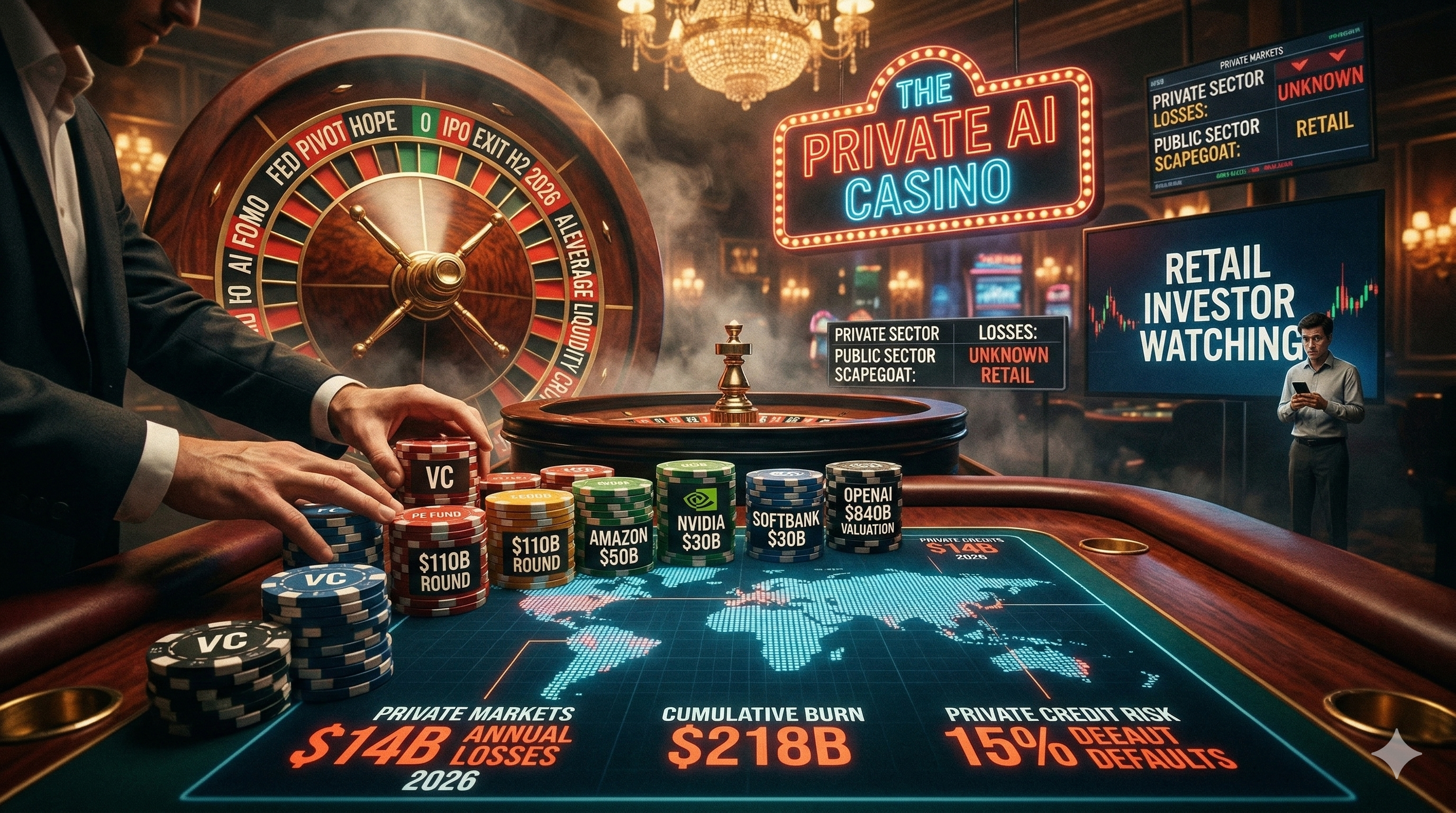
While the public markets whip around on oil spikes, geopolitics, and Fed speculation, the mainstream narrative remains unchanged: Retail investors are the reckless “YOLO” crowd. We’re told they’re the gamblers, chasing memes and options with small stakes and full daily transparency.
It’s time to flip the script. The real high-stakes casino isn’t on a retail trading app. It’s in the private markets, where “sophisticated” players—VCs, strategics, and private credit funds—are gambling with other people’s money at a scale retail could never touch.
Exhibit A: The OpenAI “Rocket”
Late February 2026, OpenAI closed one of the largest private funding rounds in history: $110 billion raised at an $840 billion post-money valuation.
The numbers tell a story of pure, FOMO-fueled euphoria. Amazon threw in $50 billion; Nvidia and SoftBank added $30 billion each. Secondary markets on Forge are still quoting shares at $729–730.
But look past the hype:
- The Valuation: A vertical climb from a $300 billion mark in March 2025 to $840 billion today.
- The Burn: Internal projections show $14 billion in losses for 2026 alone—triple earlier estimates.
- The Future: Cumulative burn forecasts range from $115 billion to $218 billion through 2029.
This is a classic “spend to infinity, dominate later” bet. It requires endless mega-infusions just to keep the lights on. Without constant, fresh capital, the math simply doesn’t hold.
Adding Steroids: The Private Credit Time Bomb
If the equity side looks like a bubble, the credit side is a structural risk. The $2–3 trillion+ private credit market has deep exposure—often 30%+ of portfolios—to software and AI-adjacent borrowers.
UBS’s tail-risk scenarios (updated February 2026) are flashing red:
- Default Risks: They warn of 14–15% defaults in private credit under aggressive AI disruption.
- Systemic Loss: This equates to a potential $300–420 billion in losses across leveraged finance.
- The Early Cracks: We are already seeing redemption halts, widening BDC discounts, and liquidity tightening.
These aren’t “safe yield” plays. They are leveraged bets on models that might get eaten alive before they can refinance. The entire sector is effectively betting on the Federal Reserve to slash rates. It is the last lever they have left, and it is a massive gamble.
The Retail “Genius” Play
The irony is palpable. Retail investors are called “dumb money” because their pain is public, daily, and transparent. But that transparency is a feature, not a bug.
- Liquidity: Retail isn’t locked into 7-year fund structures.
- Reality Checks: Retail isn’t forced to mark their assets to a “model” that ignores reality.
- The Exit: When the private bubble pops—and it will—retail is sitting on the sidelines, liquid and ready.
While the “sophisticated” institutions are praying for a liquidity event that may never come, the retail investor is insulated. Public markets are a wobbly ride, but at least they are grounded in price discovery. Private markets are currently just a leveraged bet on a story that is becoming harder to justify every day.
The Verdict
A “killer product” won’t save you in a shrinking market. We’ve seen this cycle before: dot-com, 2008, crypto winters. When the economy slows and budgets tighten, hype valuations collapse.
Will the private AI bubble hold until the exits, or crack first?
The divergence is glaring. Public markets get the blame for “gambling,” while the real degenerates are playing with house money, zero daily accountability, and access to deals that dwarf anything in the retail world.