The Ugly Truth: The AI Reckoning: Beyond Block's Cuts – Why Legacy Companies Risk Becoming Walking Dead, and What True Multiplication Looks Like

When Jack Dorsey announced on February 26, 2026, that Block (the parent of Square and Cash App) was cutting more than 4,000 jobs—nearly half its workforce from over 10,000 to under 6,000—the markets responded enthusiastically. Shares surged 20–25% in after-hours trading, and Block raised its 2026 gross profit guidance to ~$12.2 billion after strong 2025 results.
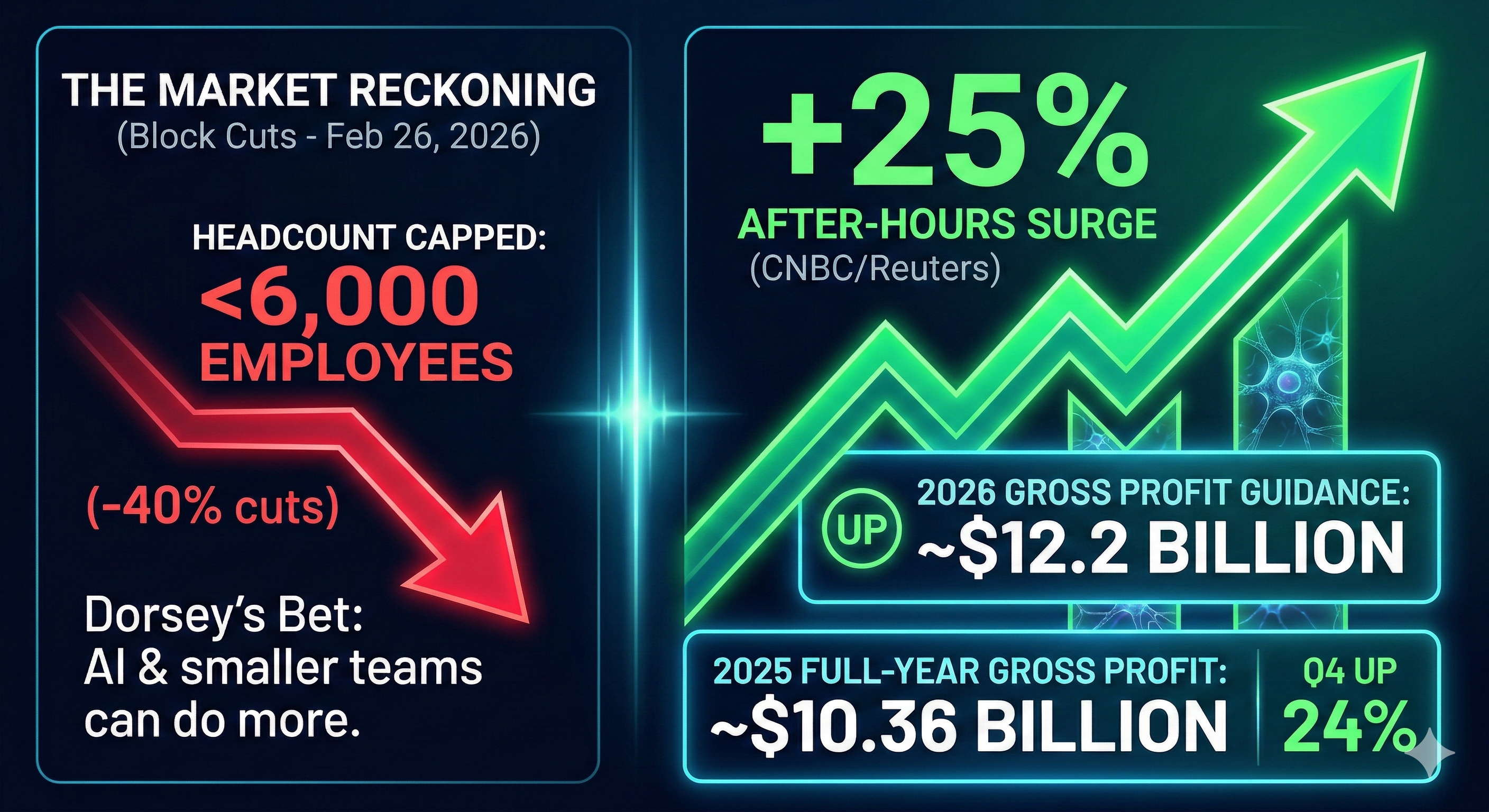
Dorsey framed it bluntly: AI and intelligence tools have fundamentally changed what it means to build and run a company. A significantly smaller, flatter team using these tools can do more—and better—faster. He predicted most companies are late and will follow suit within the year, choosing one decisive cut over gradual erosion to preserve focus and morale.
There is, of course, a valid counter-narrative: corporate bloat. Block, like many tech giants, swelled during the pandemic-era zero-interest-rate environment, growing from roughly 3,800 employees in 2019 to over 10,000 before these cuts. AI didn’t necessarily create this inefficiency, but it made it financially and structurally indefensible.
This “Block Layoff” moment crystallizes a macro shift: the end of headcount-as-moat. But the simplistic narrative—AI as a super-coder enabling mass efficiency cuts—misses the real story. The edge lies in treating AI as a triple multiplier: resource, quality, and speed. Legacy giants with abundant resources often fail not from scarcity, but from an inability to innovate at pace. AI excels by amplifying human judgment and agility—if the culture actually shifts.
The Surface Narrative vs. the Deeper Trap
On the surface, AI accelerates coding, reduces headcount, and boosts margins. In 2025, companies cited AI in 54,836 announced U.S. job cuts, up dramatically from prior years. Executives make these moves in anticipation, not proven ROI—Harvard Business Review’s survey of 1,006 leaders found ~60% tied cuts to AI expectations, but only ~2% linked them to delivered value.
Legacy companies face structural headwinds: massive codebases in outdated architectures, data silos, and integration friction (85%+ of tech leaders cite legacy systems as the top barrier). Employee resistance compounds it—fear of obsolescence, skill atrophy, and top-down rollouts without training create pushback or quiet sabotage.
But the deeper trap is philosophical. Legacy cultures optimize for human coordination at scale: meetings, hierarchies, incrementalism. AI flips the physics—enabling one domain expert to explore 10× more hypotheses, synthesize cross-domain insights, and iterate in hours. Incumbents aren’t just slower at coding; they’re slower at thinking boldly.
AI as Triple Multiplier: Resource, Quality, Speed
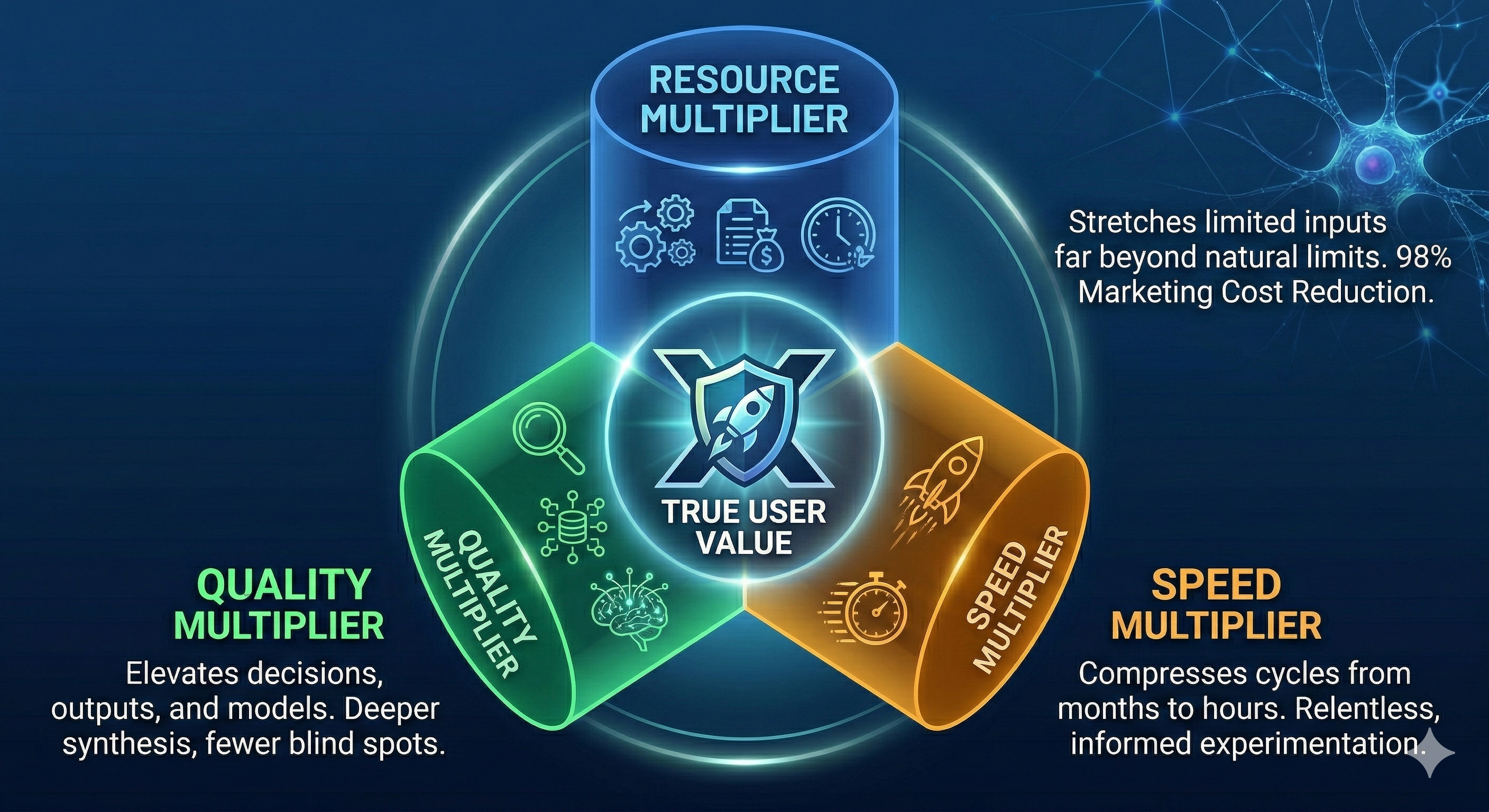
The most accurate lens isn’t “AI replaces humans” or “cuts costs”—it’s a triple multiplier:
- Resource multiplier — Stretches limited inputs (budget, time, people) far beyond their natural limits.
- Quality multiplier — Elevates decisions, outputs, and models through deeper synthesis and fewer blind spots.
- Speed multiplier — Compresses cycles from months to hours, enabling relentless experimentation.
For resource-constrained builders like a founder-led, no-VC operation such as retailtrader.ai, this is existential. We never had agency budgets or endless headcount. Scaling meant avoiding waste: testing paid channels, quickly spotting diminishing returns, and pivoting when channels dried up. AI synthesized case studies, competitor data, and patterns to guide decisions—rapidly.
One clear win: early broad keyword campaigns burned budget with low ROI. AI-driven research across fintech growth stories highlighted retargeting’s superiority for warm audiences. That pivot cut our marketing bill by 98% while sustaining (and growing) acquisition.
SEO was even tougher. Fintech is deep YMYL (“Your Money or Your Life”) territory, where Google’s E-E-A-T standards are unforgiving. Content alone isn’t enough; legitimacy signals are mandatory: real physical address, verifiable phone number, consistent NAP, transparent policies. Without them, even exceptional tools get buried. AI accelerated this discovery: rapid scans of guidelines, competitor autopsies, and forum insights surfaced the barrier in days, not months of trial. We adapted, unlocking sustainable organic growth that outsourced approaches often miss.
Beyond marketing, the multiplier shines technically: strategizing neural architectures, researching comparable models, and cross-pollinating ideas. This isn’t about the volume of code (though 98–99% is AI-written); it’s about knowing what to build before investing effort.
On the neural network side, the acceleration is even more pronounced. Training strategies and iteration cycles speed up significantly—often by orders of magnitude—because AI tools explore architectures, hyperparameters, and data augmentations intelligently rather than brute-forcing them.
What used to require days or weeks of manual tuning, multiple expensive GPU runs, and endless trial-and-error now happens in hours. Specifically, AI accelerates this process by:
- Intelligent Initialization: Suggesting promising starting points and simulating outcomes across variations before heavy compute is even deployed.
- Failing Faster: Spotting failure modes early, preventing you from wasting time and money on dead-end experiments.
- Precision Tuning: Iterating on loss landscapes and regularization techniques with far fewer actual training passes.

The result is a massive cost saver. Compute bills drop dramatically, and the quality of the final model improves faster through rapid, informed feedback loops. For a bootstrapped operation, this turns what could be a prohibitive technical barrier into a manageable part of weekly progress. It lets human domain knowledge dictate the direction, while AI handles the heavy lifting of exploration.
Even resource-rich companies benefit most here. They rarely lack people or money—they lack speed and bold iteration due to bureaucracy and risk aversion. AI cuts through: faster hypothesis testing, higher-quality synthesis, more efficient allocation. Leaders who embed it as an amplifier unlock growth and margins that headcount alone can’t deliver.
There’s a whole ecosystem of hype around what it means to be an “AI-native” startup. Founders and investors throw the term around like a badge—flashy agent swarms, autonomous workflows—often with little more than wrapped APIs and polished demos. The label has become diluted.
But users cut through that quickly. The flashy experience dies the moment they realize it does nothing meaningfully useful for them. True value shows in outcomes: does it help traders spot probabilities faster and with higher confidence? Does it cut marketing waste by 98%? The real test isn’t how “native” something claims to be—it’s whether the end user walks away thinking, “This just made my life/work/trading materially better.” Anything less is hype.
The Interoperability Cliff Ahead
With AI-native products and agent swarms proliferating, interoperability emerges as the next bottleneck. Agents excel in silos but falter coordinating across tools, models, or legacy systems.
In trading and fintech, siloed signals, execution, risk, and compliance agents create latency, trust gaps, and handoff errors. For example, a lightning-fast execution agent is useless—and potentially disastrous—if a disconnected risk agent fails to communicate a sudden volatility spike in real-time. Unified platforms avoid this; fragmented ones become liabilities. Expect massive focus on orchestration layers and emerging standards in 2026–2027.
Walking Dead Risks: The Human & Competitive Fallout
A 40–50% cut like Block’s can buy time. But it carries serious risks of creating “walking dead” organizations: morale collapse, talent flight, and reduced innovation capacity that faster AI-native competitors exploit.
Large-scale reductions often trigger layoff survivor syndrome—anxiety, guilt, and burnout among those who remain. Institutional knowledge evaporates, and top talent quietly exits. High-caliber people—AI engineers, domain specialists, product thinkers—typically flock to growing companies that signal momentum. Shrinking ones carry a stigma of uncertainty.
Ron Shevlin’s Forbes critique called Block’s 40% cut “overly aggressive” and the AI rationale “overstated,” noting: “Attracting top AI talent while being known as a company that just cut 40%… could pose a new problem.” Departing talent often lands at high-growth players.
Dorsey bets on a smaller, flatter, intelligence-centric culture flipping the script. If executed well, Block could emerge reborn. But most cutters won’t fully rebuild around amplified cognition—they’ll treat AI as a headcount hammer. Those become walking dead: alive on efficiency metrics today, irrelevant tomorrow.
What Builders Should Do
The macro change isn’t layoffs—it’s who reimagines building entirely.
- Start AI-native if possible — blank slates win.
- Use the triple multiplier for the 99% — ideation, strategy, cross-domain swings, not just code.
- Prioritize trust signals — YMYL compliance and unified workflows matter from day one.
- Watch for agent standards — orchestration is the next major investment focus.
The companies that win won’t have the biggest teams or the most resources. They’ll have the highest idea velocity per person, the deepest domain leverage, and the seamless agent ecosystems that deliver real user value.
We’re early in the shift. The walking dead shuffle; the multiplied accelerate.