AI Is Not Hype, But the Massive Buildout Will Take Much Longer Than Expected
The last couple of weeks have been brutal for the market, especially for AI-related stocks. The Nasdaq Composite closed at 20,948.36 on March 27, 2026, down over 2% that day alone, extending a painful correction.
In my previous video I warned we might see a significant correction or even bearish pressure. Today I want to share my updated thoughts on where we stand and what I expect going forward.
Alpha in the Chop: +33.88% Over 6 Months and Our Strategic Expansion
It is easy for anyone to look like a market genius in a parabolic bull run. True systematic edge, however, is proven when the tide turns.
Over the last six months, the equity markets have been a brutal, choppy, sideways mess that has punished both buy-and-hold investors and trend-followers alike. From September 26, 2025, to March 20, 2026, the performance of the major indices tells the story:
- S&P 500 (SPY): -2.37%
- NASDAQ (QQQ): -4.35%
- DOW (DIA): -1.59%
In that exact same out-of-sample window, the core CNN-LSTM engine behind retailtrader.ai generated +33.88% across my live brokerage accounts.
Beneath the AI Narrative: The Fall of the Market Generals

The AI boom remains the loudest story in markets—hyperscaler capex announcements, data-center expansions, and the long-term promise of transformative productivity continue to dominate headlines, earnings calls, and investor attention. Beneath that surface, however, a clearer and more pressing dynamic is unfolding: the market’s leadership stocks—the “generals”—are under sustained pressure from geopolitical escalation, severe energy market disruptions, rising inflation risks, and deteriorating risk sentiment. This goes beyond routine tech “digestion”; it’s leadership exhaustion amid real macro and geopolitical headwinds, while AI infrastructure players (the “shovel sellers” of the gold rush) press forward aggressively.
Bear Market Warning: Why This Choppy Action Feels Like the Early Stages of a Prolonged Downturn (March 2026 Update)
The last few weeks have been brutal for anyone trying to trade directionally. The market’s been extremely choppy—spiky up days followed by sharp reversals, massive short squeezes, and volatility that’s starting to feel less like a healthy correction and more like the drawn-out grind we see in the early phases of bear markets.
I don’t usually jump into frequent market commentary—I’m more focused on building tools and community at retailtrader.ai—but the recent price action has me paying close attention. Here’s a breakdown of what I’m observing right now.
The Ugly Truth: The $730 Billion Elephant in the Room: Why SoftBank Could Be the Pin That Pricks the AI Bubble
As a retail trader, my bread and butter is the short-term: momentum, technical breakouts, and rapid execution. But surviving in the markets requires periodically stepping out of the trenches. It requires adopting a contrarian, long-term philosophy—akin to the legendary Ken Fisher—that forces you to question the prevailing noise, look at market history, and spot the macro risks that everyone else is too euphoric to see.
Right now, the market is blindingly euphoric about Artificial Intelligence. But if you zoom out and look closely at the financial engineering funding this boom, you’ll spot a massive elephant stomping around the room: SoftBank Group (SFTBY).
The Ugly Truth: The Ergodicity of Ego: Why High-Validity Professionals Fail in Markets
 Visualizing the intersection of rigid engineering structures and fluid market data.
The Domain-Transfer Paradox
In the deterministic worlds of engineering, science, medicine, and law, certain qualities are golden: persistence, root-cause analysis, and deep domain expertise. These skills deliver reliable, repeatable results because the underlying systems are largely stationary or semi-deterministic. In these fields, intelligence plus effort yields a linear, outsized edge.
Financial markets operate under a completely different set of Kolmogorov axioms. Prices follow processes that are fundamentally probabilistic, characterized by Geometric Brownian Motion (GBM) coupled with a fragile, low-amplitude layer of predictability. This duality tempts the analytically gifted into an “Expertise Trap,” leading to the systematic liquidation of professional capital.
The Ugly Truth: The Ugly Math of Venture Capital: Why "Nobility" is a Poor Operating System
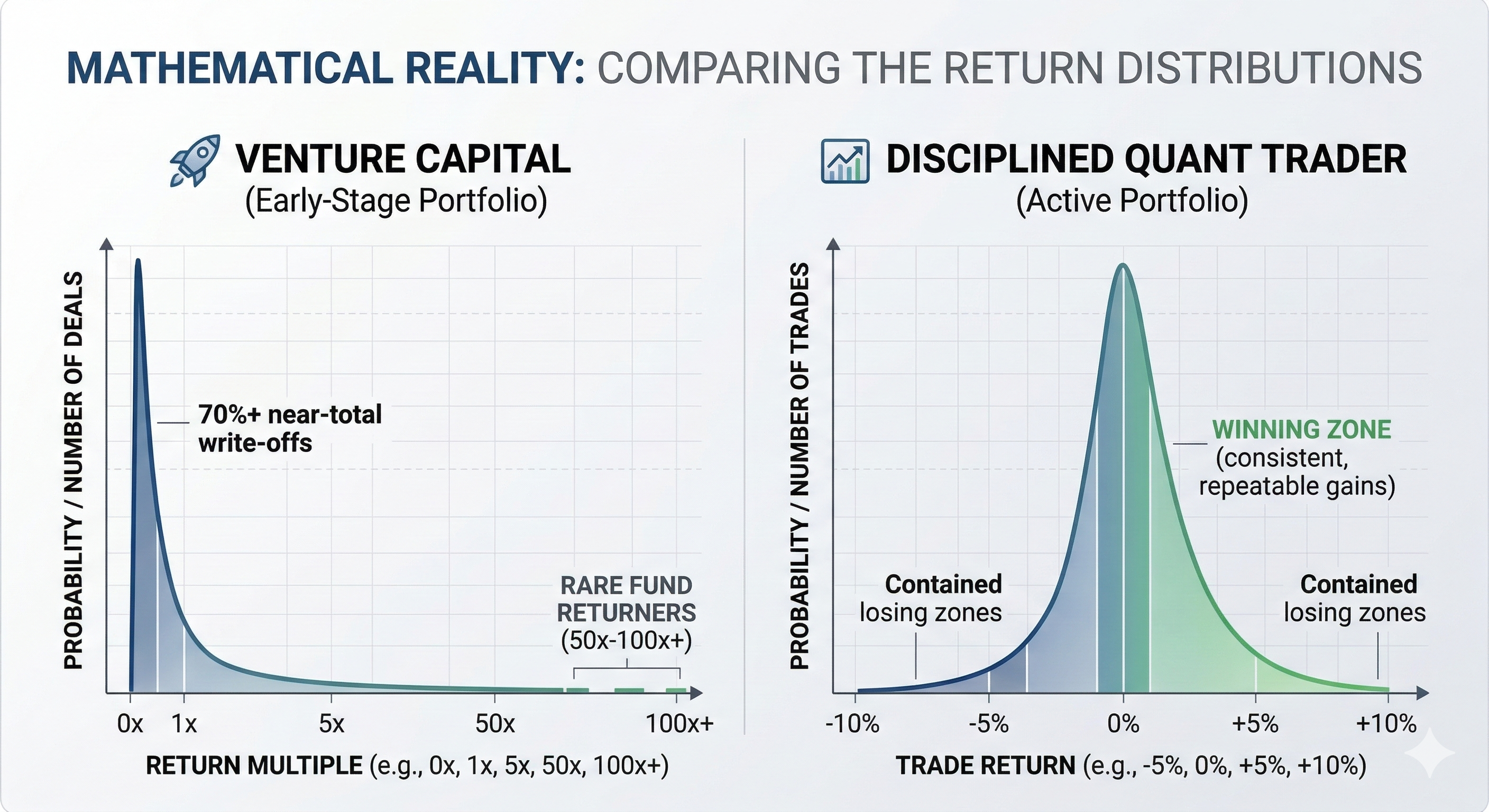
Venture capital is sold as visionary investing: brilliant partners spotting the future, backing disruptive teams, and reaping massive rewards through pattern recognition and conviction.
The media loves the narrative—hoodies at Davos, unicorn origin stories, “genius” bets on the next big thing.
But let’s strip away all the glamour, the prestige, the marketing, and look at early-stage VC purely as a mathematical and scientific problem.
From a probabilistic perspective, VC returns follow an extreme power-law distribution—fat-tailed and Pareto-like, not a normal bell curve. Recent data and benchmarks confirm the structure:
The Ugly Truth: The Real Casino: Why Private AI Markets Are the New Gambling Hub

While the public markets whip around on oil spikes, geopolitics, and Fed speculation, the mainstream narrative remains unchanged: Retail investors are the reckless “YOLO” crowd. We’re told they’re the gamblers, chasing memes and options with small stakes and full daily transparency.
The Ugly Truth: The End of the $1M Seed Round: Bootstrapping with AI & Zero CAC
I was at an investor meeting the other day. It wasn’t for my own company, but I got to watch a lot of founders proudly talking about their businesses. It reminded me of all the posts you see on LinkedIn where people brag about raising $10 million from a venture capitalist like it’s the ultimate achievement.
The Ugly Truth: The AI Reckoning: Beyond Block's Cuts – Why Legacy Companies Risk Becoming Walking Dead, and What True Multiplication Looks Like
When Jack Dorsey announced on February 26, 2026, that Block (the parent of Square and Cash App) was cutting more than 4,000 jobs—nearly half its workforce from over 10,000 to under 6,000—the markets responded enthusiastically. Shares surged 20–25% in after-hours trading, and Block raised its 2026 gross profit guidance to ~$12.2 billion after strong 2025 results.